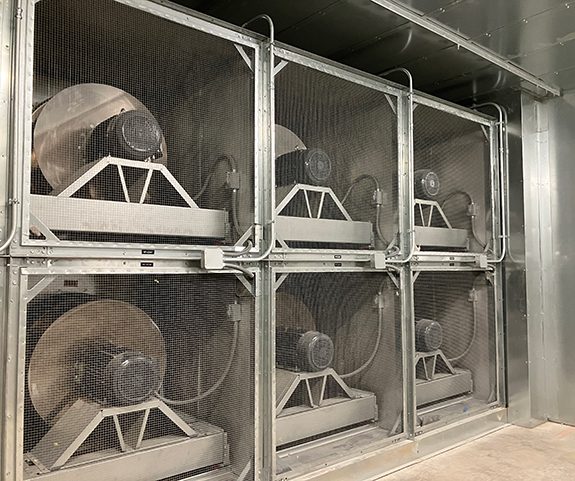
Large and small fan array systems are very common in air-handling systems, and they can bring many benefits to a project, including:
- Reduced energy use due to reduced system effect
- Improved redundancy
- Improved packaging/smaller footprint
However, these arrays are subject to some issues that don’t normally arise with single-fan operation. In commissioning, we occasionally observe fan array systems operating in a surge condition: At least one fan is operating in aerodynamic stall, spinning but not moving air. This occurs when the fan is operating too far to the left on its fan curve, where static pressure is too high and flow too low. The multiple fans operate in a region of instability where the flow/pressure point can be met with different numbers of running fans.
The diagram below, from Improving Fan System Performance: A Sourcebook for Industry (U.S. Department of Energy and Air Movement and Control Association International, 2003), illustrates the phenomenon.
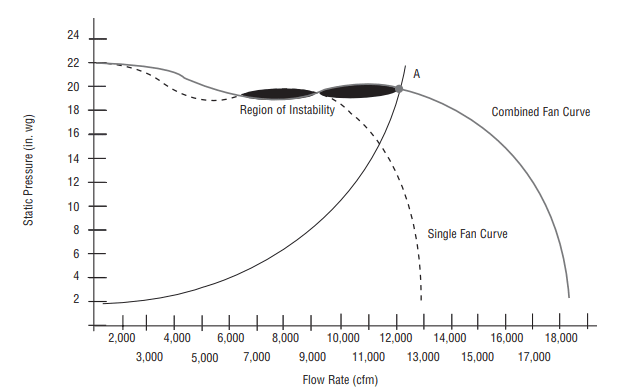
One clue that this phenomenon is occurring involves fan modules operating at the correct speed but different power levels, as measured at the VFD. Low measured airflow at the fan inlet relative to other fans in the array is another diagnostic possibility. Inlet backdraft damper behavior may even provide an indication. In our commissioning efforts, we’ve observed a four-fan array where one of the backdraft dampers would drop closed, indicating its fan was in stall, with the remaining three fans running normally. Manually pushing a different backdraft damper closed would cause that fan module to go into stall (by reducing its airflow and pushing its operating point to the left of the curve), and the originally stalled fan would come out of stall with increased airflow (and its damper would open, whack-a-mole style).
After the building occupancy and load increased, the operating point became stable with four fans, and the issue went away.
In facilities that don’t have fan inlet flow sensors, individual fan VFDs, or backdraft dampers, this issue can be more difficult to spot. I suspect it may be somewhat common and results in reduced efficiency for fan array systems.
Some strategies to mitigate fan array instability include:
- Staging operating fan modules based on capacity and, possibly, pressure.
- Reviewing TAB reports for variation in individual fan HP or amp draws.
- Specifying proprietary fan array technology that stages fans to avoid surge, or that changes the fan inlet geometry.
Contact us to learn more about how we can help with your fan array systems.
Author: Laurence Steiner, PE, LEED AP, Vice President, GBA Wisconsin